What Controls Size of Upload Photos to Facebook


WHY DO PHOTOS LOOK BAD ON FACEBOOK?
Posting and processing images on Facebook has been a problem for me for quite a while. Pretty much all my social and photographic activity ends upwards on that platform and in the absenteeism of more physical wallspace for prints, my Facebook wall is my simply real artistic outlet.
How frustrating to find that Facebook is scrupulously compressing my images into nasty, crunchy low particular files. It'southward a trouble all us photographer's face.
We want to show the globe our all-time piece of work but unfortunately, the world is on Facebook...
So, how to fight dorsum?
None of what follows is going to hateful your images will be perfect on Facebook merely they may well look a lot better than they did previously.
HOW TO UPLOAD THE BEST POSSIBLE PICTURES TO FACEBOOK
-
Add extra effulgence. Facebook has a white background that will brand your images expect darker and bleed them of colour.
-
Don't compress your images - Facebook volition compress the image a second fourth dimension!
-
Consign them at full 300DPI resolution
-
Apply a JPG Format at 100% quality
-
Make certain the longest edge is exactly 2048px
-
Save the sRGB Colour Profile into the Prototype
-
Acuminate your photograph for screen
-
Use a Vertical Crop if possible.
Add together Actress Brightness & A LITTLE SATURATION
Facebook has a white groundwork which volition drain the image of brightness. Your image will look darker against a white background.
This is why well-nigh photographers use a dark grayness / black groundwork on their websites, this boosts the appearance of brightness and saturation.
DON'T DOUBLE YOUR COMPRESSION
In that location are a whole raft of blogs and articles out in that location which spend a lot of time telling people to compress their images when exporting for web employ to around seventy% quality.
That's good advice for posting to your website or to a Wordpress blog because the file size will be much smaller and load much quicker and you lot definitely desire your website to await skilful and load speedily.
However, information technology doesn't brand a positive divergence for Facebook considering all that volition happen now is that Facebook will shrink your already compressed shot even more than!
I tested this extensively on Facebook. I uploaded a maximum quality image and a 70% 72DPI epitome to facebook on a standard group timeline. I and so downloaded each image to compare them.
I found that the previously uncompressed image had been compressed by Facebook and was now simply 22% of the original size. However, the pre-compressed image was 20% of the full resolution original. Small gains but a gain nonetheless. Comparing the newly downloaded images to each other revealed that the uncompressed file was 11% larger than the pre-compressed file after Facebook had finished with them.
I went even further. I re-uploaded (is that a give-and-take?) the previously 70% compressed epitome to Facebook. Information technology should have already optimised this image right? Facebook should have accustomed information technology with open arms and done precisely zero. Not a hazard! The image got compressed further - another 11% in fact!
DON'T Downwardly SAMPLE YOUR DPI
Ignore all the advice nearly downsampling your pic to 72DPI (to preclude theft). On Facebook, it will brand no divergence - they are going to compress the crap out of information technology anyway... Get out information technology at 300DPI and allow Facebook handle it.
PNG CONVERSION
While information technology was certainly the case a while back that Facebook actually posted PNG's (they can't be compressed because they are a lossless format). Facebook now converts them to JPG'south on upload so compresses them farther.
So while information technology was true that PNGs looked manner better in the past, it is no longer true.
The theory behind exporting as a PNG and uploading to Facebook is that there will merely be 1 phase of compression. This occurs in Facebook.
If y'all export to your hard drive in JPG, well that ways you have already applied one level of compression in the conversion from RAW to JPG. Then, when Facebook gets the paradigm, information technology will compress it again.
When I tested this myself, I found the deviation to be undetectable. When I downloaded the Facebook converted PNG -> JPG file and compared information technology to the Facebook JPG -> JPG converted file, it was an identical size and looked identical to my eye.
So you lot can certainly effort the PNG play a trick on simply I constitute no practical benefit. The downside is that PNGs are bigger and take up more space on your hard drive.
DIFFERENCES Betwixt TIMELINE, GROUPS AND PAGES
There is a lot of information nigh the differences of posting to Timelines, Groups, Pages and Photograph Albums (on high quality).
I have bought into this in the by only I decided to actually test the principles. I uploaded my sample images to my timeline, a group timeline, my folio and using 'high quality' in an album.
Approximate what? Each one of them treated the image identically. When downloading the paradigm I could see no difference whatsoever betwixt them when pixel peeping at 100%. More than this, they were all of an identical size - even the so-called 'high quality' paradigm!
Bottom line. It seems to make no difference where you postal service.
All-time CROP RATIOS
Sizing images for social media is always a chip of a moving goal post. The best sizes change all the time! But there has been a major tendency recently. More and more people are browsing the internet on phones and take yous noticed what format the boilerplate phone is? I'll give y'all a hint, it's vertical.
Whereas it used to exist the instance that verticals were shrunk into tiny pics on Facebook (because nosotros all used computers to look at these sites) at present nosotros utilize smartphones and the vertical/portrait image is back with a vengeance.
Sites similar Pinterest & Tumblr all promote verticals and Facebook has simply joined the club. You will note that your image will take upward a far bigger piece of screen real estate (on phones it is called the viewport) than they did in the past.
If you tin't postal service a vertical, then at least postal service a square. The 6x6, the Hasselblad medium format ratio, is back - thank Instagram for that!
WHAT SIZE Photo TO UPLOAD TO FACEBOOK?
Sizing your image is catchy. Larger images most definitely look better on Facebook, but they are at take chances of theft. Not so much for impress, but for use on websites and as web images.
I'm not sure there is much we can do almost that other than to post small images that don't scale very well. The adept news (or bad?) is that hardly anyone will click your image to view it full size anyhow. The measly timeline width is all you are actually going to need. And recollect, most people volition exist looking at it on a tiny phone screen anyway.
Facebook actually publish what they do to images...Yeah, who knew! Check the latest advice here.
The current supported sizes for normal images are:
• 720px
• 960px
• 2048px (size will yield the best quality and fewest pinch artefacts)
Then I went alee and tested 2048px v 1080px v 960px and I got some very interesting results.
When looking at the images side-by-side on the timeline I got a hint that the 2048px images were marginally better. You can't download the image from the timeline for comparison and then I had to do information technology by middle.
When opening the images full size, the supported file sizes of 2048px and 960px looked amend than 1080px but information technology was very marginal between 960px and 1080px.
When downloading the images from Facebook and downsampling it was absolutely articulate that the 2048px won out over the rest.

The ruby box indicates an surface area I masked to show the noise sample from a 2048px image compared to a 1080px image after downsampling to 1080px - 2048px is clearly a lot better!

Is information technology me or is the lower 2048px image marginally sharper than the 960px in the timeline? Either way, in that location is very niggling in information technology when comparing timeline images.
The sizing conundrum is therefore clear. If you want the best quality and are less worried about theft, then 2048px wins. The other supported Facebook sizes of 960px and 720px come second and 3rd. Avoid not-standard sizes, they appear to be resampled to achieve the nearest standard size in terms of equivalent DPI.
Utilise sRGB COLOUR PROFILES
Colour, as almost photographers know is a very tricky problem. The reason is that our cameras can capture more colours than the internet (standard sRGB) tin can show.
More than this, nosotros take absolutely no control over whatever cruddy and poorly calibrated screen our viewer is staring at. The typical issues with screens are ordinarily to do with gamma levels and brightness as well equally poor colour profiles.
Simply expect, there is more bad news! Much of the software that people are using to browse the internet is not colour managed either (and nor is much of the photo-browsing software loaded on our own computers - e.chiliad Windows 10 Photos)!
I tip I can give y'all is to drag your JPG into a Mozilla Firefox browser window to run across how it volition display on the internet. You lot can do this because Firefox has the peachy advantage of beingness a fully colour managed browser.
When exporting your paradigm from Lightroom or Photoshop ensure you take converted the colour profile to the internet standard sRGB.
This step is VITAL. The reason is to cater to two groups of users; wide gamut displays and tablet/smartphones. Wide gamut displays demand to know that the prototype is in sRGB or they will non display properly - they volition be over saturated.
Smartphones on the other hand exercise not generally recognise embedded ICC profiles. If nosotros convert our images using Prophoto or Adobe1998 colour spaces they will announced nether saturated on these devices. Converting to sRGB on consign means that they will interpret the image correctly - even though they don't know the image is sRGB.
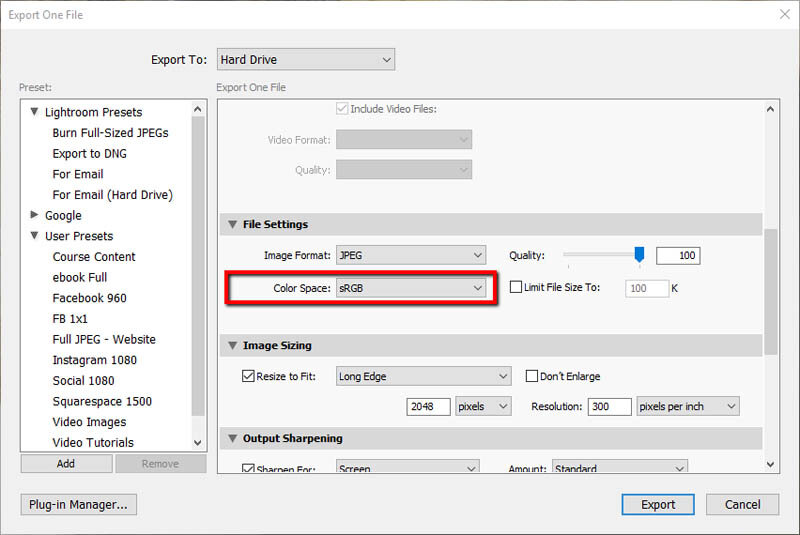
Hither'southward the Lightroom CC dialog - Ensure your colour space is prepare to sRGB, the internet 'standard' if I tin can call it that.
Even when doing this, I accept noticed that Facebook flattens colour and contrast. I'd advise testing a few posts on Facebook and giving your export settings a wee boost to saturation and contrast specifically for Facebook posts.
FACEBOOK LIGHTROOM SETTINGS
(Save this as an Consign Preset)
If you lot didn't already know you can create specific consign presets in Lightroom and and then use these for all your Facebook images. You can even create collections that practise this for you automatically once you have finished editing - but that, maybe, is meat for some other blog post.
Here's some other tip Use a carve up Lightroom Catalogue to manage all your social media output. I don't like JPG's cluttering up my processing catalogue.
I would also note that Lightroom omits settings for resizing and sharpening that are included in Photoshop. This added level of control may exist of import when reducing the size of the epitome, yet, I accept non actually tested it.
Your Lightroom CC settings should be equally follows:

Want TO Take YOUR PHOTOGRAPHY TO THE Side by side LEVEL?
Source: https://willgoodlet.com/blog/optimising-facebook-images
0 Response to "What Controls Size of Upload Photos to Facebook"
Post a Comment