When it comes to asthma, there’s no 'one size fits all' treatment
Advertisement
Health
When it comes to asthma, there's no 'one size fits all' treatment
A new gear up of guidelines recognises the complexity in the interaction between a patient's genetics and the environment.
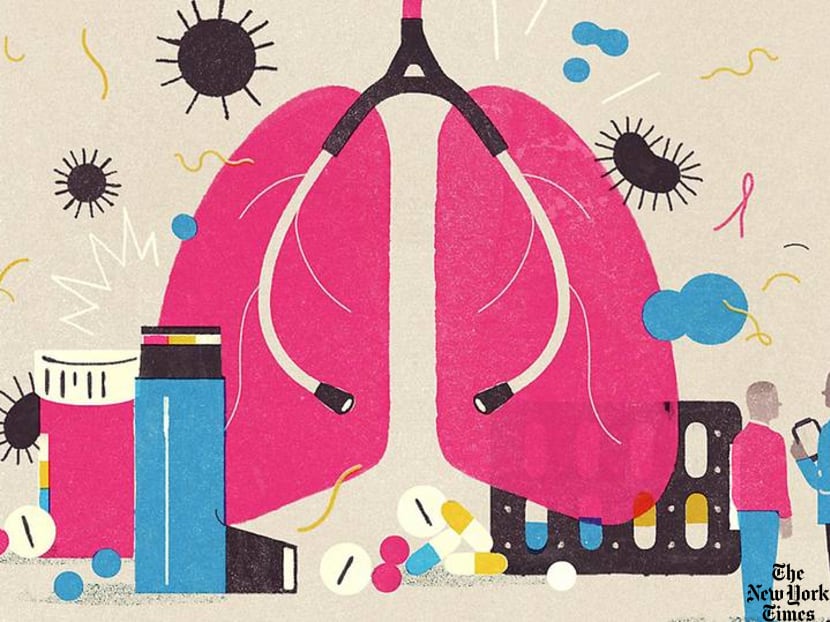
(Fine art: The New York Times/Gracia Lam)
Asthma may be a disease with ane name. But experts say that unbeknown to near people who take it, it is non simply ane affliction, nor is at that place a "one-size-fits-all" treatment for information technology.
Rather, as detailed in a new 54-page gear up of guidelines developed by an expert panel, in the xiii years since the last guidelines were issued, tremendous progress has been made in understanding the causes and physiological effects of diverse kinds of asthma and the dissimilar approaches needed to care for them and minimise flare-ups in children and adults.
The guidelines were published in December in the Periodical Of Allergy And Clinical Immunology.
"In recent years, we've recognised that anybody'south asthma is a piffling different, with different underlying mechanisms, and the paradigm for treating it has changed completely," said Dr Michael Wechsler, an asthma specialist at National Jewish Health in Denver.
READ: How climatic change may increase your risks of asthma, middle disease and stroke
Asthma is now recognised as a far more than complex condition than experts realised in 1991 when the first comprehensive guidelines were issued.
It is now considered a syndrome with many different characteristics, or phenotypes, that result from the interaction between a person's genetics and environment.
Also, though not discussed in detail in the updated guidelines, the newest treatment with what are known every bit biologics is heralding new forms of personalised therapy for patients with severe asthma that is not well-controlled by other, admitting cheaper, remedies.
Biologics are drugs made from modified molecules from the cells of live organisms designed to target specific disease pathways that culminate in asthma symptoms.
"The last xiii years have seen an explosion of new strategies, new concepts, new understanding of mechanism, new drugs and new treatments," Dr Wechsler said in an interview.
"In just the last v years, v new drugs have been approved for treating asthma."
The new guidelines can be especially helpful for people being treated for asthma, balmy or astringent, that is at present not adequately controlled.
More than than half of asthma patients are treated by primary care doctors, with referrals to specialists like pulmonologists or allergists when their condition is severe or doesn't answer well to treatment, said Dr Michelle Cloutier, professor emerita at the University of Connecticut School of Medicine, who chaired the expert console.
Asthma afflicts most 25 one thousand thousand people in the United States, including five.five one thousand thousand children.
Information technology is not an infection, although the torso reacts as if an enemy had attacked information technology. Rather, asthma is a chronic respiratory affliction in people whose airways go inflamed in response to various triggering substances or behaviours.
The new guidelines tin be specially helpful for people beingness treated for asthma, mild or severe, that is now not fairly controlled.
The inflamed airways swell and narrow and the muscles surrounding them tighten, causing a bronchospasm. Unless the bronchospasm is rapidly reversed, it tin become very difficult to breathe and consequence in hospitalisation or decease.
Although people with asthma always have some degree of airway inflammation, they are peculiarly sensitive to certain factors that tin make the inflammation much worse and result in laboured animate.
Thus, some people with asthma take environmental allergies, for instance, to pollen, creature dander, dust mites, rodents or cockroaches, that when encountered, tin trigger an asthmatic attack.
Others are sensitive to irritants in the air, like tobacco smoke, air pollutants, or substances with stiff odours.
For example, Dr Wechsler said, "Even what is used to make clean tin be irritating to a person with asthma."
READ: Could at that place be air pollution inside your home? Here's what to await out for
For some people with asthma, a viral infection, similar the flu or cold, or use of a medication like aspirin, an NSAID or beta-blocker, can enhance inflammation in the airways and result in laboured breathing.
Still, others experience constricted airways when they practice, particularly in common cold weather.
Even strong emotions, like fear, anger, excitement or laughter, and sudden changes in the weather are problems for some people with asthma.
Although several people I know with asthma feared they would exist especially susceptible to contracting COVID-19 and becoming severely sick, the evidence has not shown an increased risk either in contracting the coronavirus or developing a worse infection if they did, Dr Wechsler said.
In fact, he added, "treating asthma may even protect against COVID".

Researchers now recognise that the triggering event of an asthma attack tin have different manifestations within the airways and therefore respond better to different treatments.
As Dr Cloutier explained, in allergic asthma, inflammatory cells chosen eosinophils collect in the airways, simply when a viral infection triggers the inflammation, cells called neutrophils are released, warranting a different handling.
The new guidelines highlight the value of a measurement called FENO that stands for partial exhaled nitric oxide, a biomarker described as useful in correctly diagnosing and adequately treating asthma in different patients.
For children aged 5 and older, a nitric oxide measurement can assist confirm the diagnosis of asthma and evaluate the effectiveness of treatment.
Even strong emotions, similar fear, anger, excitement or laughter, and sudden changes in the atmospheric condition are issues for some people with asthma.
Although the guidelines do not provide hard-and-fast rules, they offering valuable treatment suggestions when currently used remedies do not result in the best relief possible.
For case, the panel stated unequivocally that encasing mattresses and pillows in allergy-protective covers is not in itself an adequate remedy for someone allergic to grit mites.
"Single-component interventions ofttimes exercise non work" in efforts to control indoor allergens, the console wrote.
Amidst the combined approaches suggested were using pesticides against firm-dust mites on carpets, mattresses and furniture; air-filtration systems and air purifiers, including those with HEPA filters; removal of wall-to-wall carpets and area rugs, at least in the allergic person'southward bedroom; and mould mitigation.
READ: There are 7 steps to employ an asthma inhaler correctly – have yous been wrong?
The study likewise cautioned against relying on a negative result from an allergy exam if the person reports worsening symptoms when exposed to the allergen tested.
On the other paw, some patients who examination positive on an allergy examination may not react to that substance in existent life. Some may have developed a tolerance to the allergen that could be undone by attempts to reduce the patient's exposure to it.
In sync with current trends in medicine toward shared decision-making, the panel emphasised the value of doctors and patients collaborating to come up with the most practical and effective approach to care for asthma in different individuals.
For case, the panel wrote, "allergen mitigation interventions may be expensive or difficult for patients to use or maintain".
Doctors were urged to take into business relationship the severity of the patient'south symptoms and life circumstances before recommending remedies that could be too challenging for the patient.
Patients should exist engaged in treatment decisions, Dr Cloutier said.
Those with balmy affliction, for instance, might prefer to take a single medication every day and use a "rescue" medication occasionally if they develop symptoms, while others would rather use the same two medications but only when needed.
By Jane Brody © The New York Times
This commodity originally appeared in The New York Times.
https://world wide web.nytimes.com/2021/02/15/well/live/theres-no-one-size-fits-all-treatment-for-asthma.html

Recent Searches
Trending Topics
Source: https://cnalifestyle.channelnewsasia.com/wellness/asthma-no-one-size-fits-all-treatment-237896
0 Response to "When it comes to asthma, there’s no 'one size fits all' treatment"
Post a Comment