How to make your Art Project exciting: creative mixed media
Concluding Updated on Feb eight, 2017
Sometimes fifty-fifty highly able Painting students experience stuck in a rut. If your IGCSE or A Level Art Coursework project feels stagnant, repetitive, or downright deadening, you may benefit from increased experimentation with media, techniques and processes (the ideas listed below are as well perfect for using in an A Level or GCSE Art sketchbook). While it is important to remember that art-making mediums should be used in a manner that supports your ideas, in that location are times when a dash of unpredictability and thinking-outside-the-box can help.

Paint on something interesting
Time and time over again I come across students who paint or draw on white cartridge paper and zilch else. There is nada wrong with cartridge paper. Some cartridge papers – especially thick, gutsy, wetstrength ones – are cute. Sometimes, a thin, flimsy canvas (the kind that warps at the mere hint of moisture) is all you need. Merely, often, experimentation and inventiveness with media brings considerable advantage. There is a joy –a wonderful aesthetic discovery – that takes place when you pigment on something unexpected: a surface with history that brings with it colours, textures, marks and irregularities of its ain.

Describe on coloured paper
The showtime thing you can do is embrace papers of other colours. Select those that integrate seamlessly with your coursework project (creams, browns, greys and blacks are probable to be more appropriate than psychedelic pink, for instance).
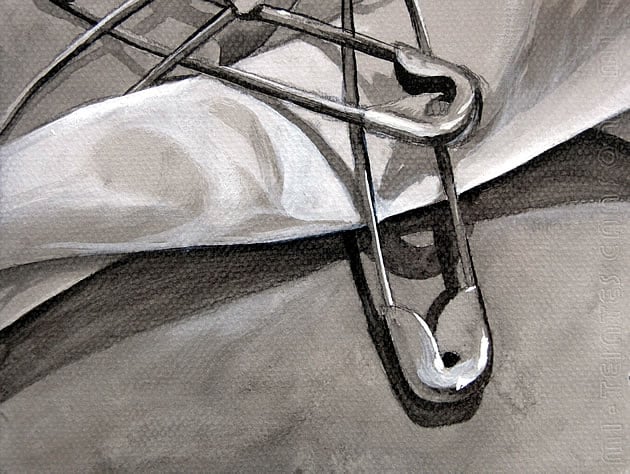
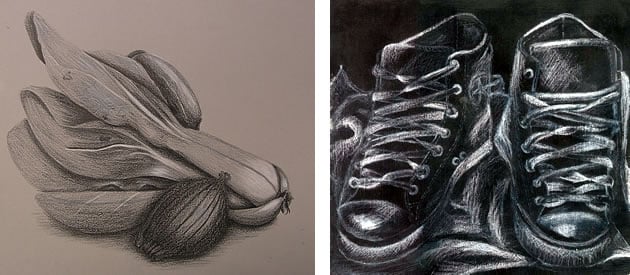
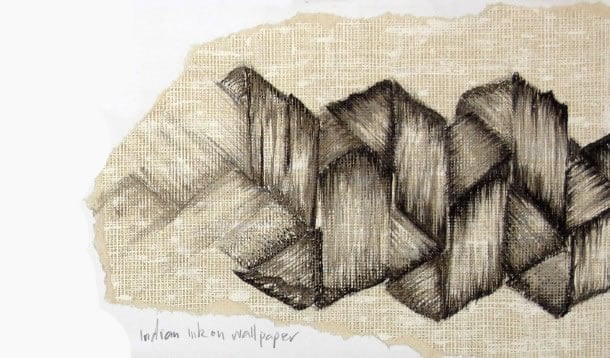
Night colours can be cracking for cartoon on with calorie-free mediums; mid-tone papers (those that are a 'medium' tone – not as well dark and not too light) are also first-class. Every bit in the Juan Gris example above and the Indian ink piece of work below, the colour of the paper acts every bit the mid-tone for the drawing; dark and low-cal areas are added as required (this results in a slice that appears three-dimensional very apace).
Embrace textured paper
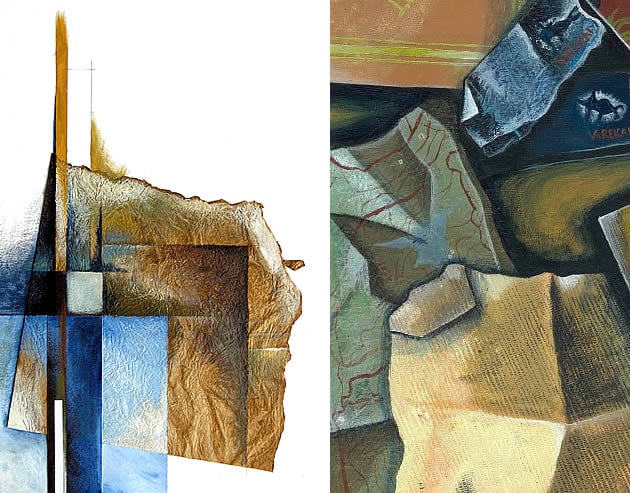
There are lots of textured papers available. Some are machine made, pressed with a uniform mesh of bumps or grooves; others are handmade, with flecks of fibre, thread, tissue and other items intertwined within the newspaper lurid. If you don't take access to textured papers, y'all can easily find or make your ain. Tear apart packaging or disassemble things y'all notice in the trash. Source whatever scraps you lot tin and draw on them, or cut, tear and mucilage them into a painting.
Detect the beauty of drawing on tracing paper
Many people don't realise that tracing newspaper is not only useful for tracing – information technology is an exciting drawing surface in its own right (see examples below past Debby Kaspari and Mercedes Baliarda). Tracing paper can exist used to make translucent overlays or glued onto white backing newspaper (be careful when gluing, as some tracing papers warp hugely when in contact with moisture). The shiny surface creates rich, sleeky images that love to smudge and blacken your easily. Permatrace – a thick, waterproof drafting movie – is particularly exhilarating: it produces some astonishing outcomes with ink.

Use ripped, scrunched, folded, ripped, or stained paper or tissue
Tissue paper tin can be scrunched and glued onto a painting (shaping as required) to create a textural surface that tin can be painted over. Every bit with other textures, dry-brushing will exaggerate them and make the fine web of creases more visible.

Paint or draw on patterned or textured wallpapers or other decorative surfaces
Intendance needs to be taken when integrating patterned items; it can exist like shooting fish in a barrel for the blueprint to dominate and overpower a work. When appropriate imagery is selected, however, patterned items tin provide excellent cartoon surfaces or collaged textile.
Integrate paper cuttings
If you experiment with drawing on paper, remember that the text becomes a part of your work; this needs to be an intentional and considered decision. If the words are legible, the message contained within the writing should be relevant or, at the very to the lowest degree, not distracting.
Example by Jonathan Derby:

Draw on book pages, pieces of rubbish or other text-based items
Many artists are achieving nifty popularity for their drawings upon found, text-based materials.
Examples past Mark Powell and Paula Swisher:


Draw on cardboard
While MDF or hardboard is a great surface to paint on, those who have to send away work to CIE are limited by weight restrictions. Paper-thin is a suitable, lightweight replacement. Card can provide a sturdy base for a painting and, when cutting-outs are glued into a work, can create elevated surfaces that segment a composition, adding depth and shadows.
Examples by Nikau Hindin and Olivier Catte:
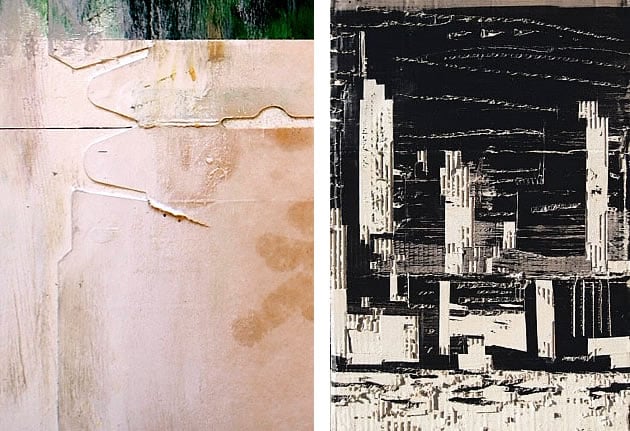
Case by EVOL:

Paint on linen, hessian, sail or fabric
While stretched canvases are unable to be posted to CIE, pieces of fabric can be cut and glued onto paper and painted upon. The fine mesh of woven thread can be left as is or hacked at and unravelled, fine threads spiralling into the artwork. Information technology is also possible to 'stretch' canvass yourself over a sturdy piece of cardboard, with the canvas edges folded behind the back of the card and stapled.
Instance by Tony Fomison:

Get wild with modelling compound
Modelling compound – used for creating thick, sculptural elements in an artwork – often becomes a Painting educatee'south best friend. Whether used with masking tape to create straight edged areas, or slapped on and scratched erratically with a stick, modelling compound is the stuff of magic. Items can be pressed into it and carefully lifted out when dry out, revealing an indented pattern and form; it can exist sanded and cut with a craft knife when dry.
Example by Amiria Robinson (left) and Jessica Fong:

Throw in everything else
If all of the above fails to inspire, create an assemblage of objects non normally associated with making art (example past Robert Rauschenberg). If you have to send your work overseas for moderation and/or assessment, deport in mind that your options are express by what is able to exist shipped through customs (for example, not organic thing, such equally bark or leaves) and past what is small, light and cost effective to post (i.e. not steel sheets). Even with these limitations, however, there are many possibilities.

When you shape or create a painting surface, in that location is something of y'all invested in the piece of work, before you even brainstorm.
Did you savor this article? Please read PART ii of this series: Painting on Grounds

Amiria has been an Fine art & Pattern teacher and a Curriculum Co-ordinator for 7 years, responsible for the class design and cess of pupil work in two high-achieving Auckland schools. She has a Bachelor of Architectural Studies, Bachelor of Architecture (Offset Class Honours) and a Graduate Diploma of Pedagogy. Amiria is a CIE Accredited Art & Design Coursework Assessor.
Source: https://www.studentartguide.com/articles/painting-media-process-technique
0 Response to "How to make your Art Project exciting: creative mixed media"
Post a Comment